5 Reasons People With Sore Backs and Stiff Knees Are Lying on a Glowing Red Mat for 15 Minutes a Day
It began in a NASA greenhouse. Now it is showing up on living room floors, and the science behind it is stronger than you would guess. Here is what is actually going on.

Key takeaways
- The lingering aches and slow recovery that arrive in your 40s and 50s track with a measurable slowdown in how your cells make energy.
- Red and near-infrared light at specific wavelengths has decades of published research behind it. NASA helped start the field.
- Clinics charge $100 to $300 a session for this therapy. A full-body mat now does it at home in 15 minutes a day.
- The mat in this article carries 1,410 LEDs, runs both wavelengths at once, and comes with a 60-day home trial.
There is a sound most of us start making somewhere in our forties.
It happens when you stand up after sitting too long. Half sigh, half groan, completely involuntary.
Maybe yours shows up on the stairs instead. Or in that first stiff minute getting out of bed. Or at 3pm, when your energy empties out for no reason you can name.
Ask about it and you will usually get a shrug and the one-word explanation everyone settles for: age.
Researchers who study how our cells make energy have a more specific explanation. And this one comes with something you can actually do about it.

Your cells run on tiny batteries. After 40, they fade.
Inside almost every cell in your body are mitochondria. Think of them as batteries. They turn what you eat and breathe into the energy your body runs on.
That energy does more than get you through the afternoon. It powers repair. Sore muscles, irritated joints, tired skin: all of it gets fixed by cellular work, and cellular work runs on that battery charge.
From around our 40s, mitochondria gradually produce less. Scientists call it mitochondrial decline, and it is one of the most studied features of aging.
You experience it as a pattern: soreness that lingers an extra day. Stiffness that takes longer to walk off. Sleep that refreshes less than it used to.
The repair crew never left. It is just working shorter shifts.
A clue from a NASA greenhouse
In the 1990s, NASA needed plants to grow on space missions, so its researchers used panels of red LEDs as a compact light source.
The plants grew. And along the way, researchers began studying something unexpected: cells exposed to specific red and near-infrared wavelengths behaved differently, and the effects on energy production and healing looked promising.
That observation grew into a field called photobiomodulation. Thousands of papers have been published since, studying these wavelengths for muscle recovery, skin, sleep and soreness.
Today you will find this light in physio clinics, dermatology offices and the recovery rooms of professional sports teams.

Then it went behind a clinic counter
Here is the part that explains why you have probably never tried it.
A red light session at a clinic runs $100 to $300. You book it like a haircut, drive there, and treat one part of you at a time.
The research points to consistency as the thing that matters most: short sessions, most days, for weeks. At per-visit prices, consistency quietly turns into a subscription costing more than a gym membership, every month, indefinitely.
So the people getting the most from this science were the ones who could rent it often. Everyone else got a sample.
The mat that brings it home
A full-body light therapy mat changes the math. One purchase, then every session for as long as you own it costs about as much as the electricity to run a reading lamp.
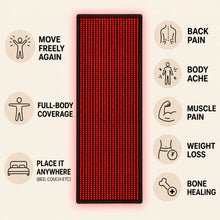
The one in this article is the Luscent Red mat. It is the size of your body, 180 by 80 centimetres, and it carries 1,410 LEDs in a dense grid from end to end.
Half of those LEDs glow red at 660 nanometres, the wavelength studied for skin and surface tissue. The other half emit near-infrared at 850 nanometres, which your eye can barely see but which reaches several centimetres into muscle and joints.
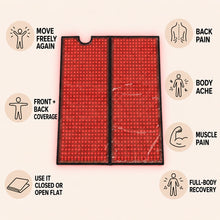
You unroll it on a bed, sofa or floor. You lie on it, drape it over your shoulders, or fold it around a knee. Fifteen minutes later it switches itself off.

So why this mat, and why fifteen minutes lying down? Five reasons.
1. It treats your whole body in one lie-down
Most home light devices are pads or wands that cover one knee or one shoulder at a time. The mat's 1,410 LEDs span from your shoulders to your calves, so your back, hips and hamstrings all get the same session at the same time. Nothing to hold, nothing to move every ten minutes.

2. The light works at two depths at once
660nm red light reaches 2 to 5 millimetres, where skin lives. 850nm near-infrared reaches up to about 40 millimetres, the territory of muscle, joints and connective tissue. Most cheap devices pick one. This runs both, simultaneously, across the whole mat.

3. The research is real, and we will show you its limits
In a controlled trial of 136 people, red and near-infrared light twice a week measurably increased skin collagen density. A review of 14 studies found faster muscle recovery in the 48 hours after hard exercise. A 14-night trial measured 63% higher melatonin in athletes using red light each evening. And where the evidence is mixed, like chronic back pain, we say so further down this page rather than rounding up. The citations sit beside the offer.
4. The effort is almost zero
Every health habit you have ever abandoned demanded something: sweat, willpower, a 5am alarm. This one asks you to lie down for fifteen minutes, most days, while you read or close your eyes. You were going to sit down anyway. The mat just makes the sitting count.

5. It costs like a device, then replaces a subscription
At clinic prices of $100 to $300 a session, the mat pays for itself in a handful of visits. After that, every daily session for years costs cents of electricity. You are not buying sessions anymore. You own the machine that makes them.
The first session, honestly described
The mat warms gently under you, the red glow is soft enough to read by, and that is the whole show. No buzzing, no heat treatment, no UV.
Most people simply feel relaxed afterwards, and in the first two weeks that is mostly what you should expect, along with easier sleep for many.
The research timelines say weeks three to six are when soreness and recovery changes become noticeable, and skin changes arrive on the slowest track. This is a daily habit with compounding returns, not a jolt.